Getting Pinterest traffic feels exciting… right up until you realize traffic doesn’t automatically equal sales. 😂
You can have Pins getting thousands of impressions. People can save your content. They can even click through to your website. Pinterest can be doing exactly what you were hoping it would do, and somehow your sales still aren’t moving.
That’s frustrating because so much Pinterest advice focuses on getting more. More impressions. More clicks. More traffic. More monthly views.
But if you’re using Pinterest to grow a business, eventually you have to ask a different question:
What are people supposed to DO after they click?
Because getting someone off Pinterest and onto your content is only the beginning.
Pinterest Traffic Isn’t the End Goal
I love getting traffic from Pinterest. Obviously. 😂 But I don’t want traffic just so I can open my analytics and admire a bigger number.
I want the right people finding my content.
If 10,000 people click something that has absolutely nothing to do with the Product I’m ultimately trying to sell, that traffic might look fantastic on a dashboard without doing much for my business.
Meanwhile, 100 people searching for the exact problem my Product helps solve could be much more interesting.
That’s why I’ve started thinking less about how much Pinterest traffic I can get and more about who I’m attracting and where I’m leading them.
The goal isn’t simply traffic.
It’s qualified movement toward the Product.
Start With What You’re Actually Trying to Sell
This is where I think Pinterest strategy gets backward really quickly.
We create Pins based on what looks cute, what’s trending, what seems popular, or what we think might get clicks. Then, after the traffic arrives, we try to figure out how the heck we’re supposed to monetize it.
I prefer starting at the opposite end.
What are you actually trying to sell or recommend?
Maybe it’s your own digital product. Maybe it’s an affiliate Product. Maybe it’s a membership, course, service, physical product, or something else entirely.
Once you know what’s sitting at the end of the path, you can ask a MUCH better question:
What would someone who could reasonably buy this Product be searching for BEFORE they’re ready to buy it?
Now we’re not chasing random Pinterest traffic.
We’re intentionally creating entrances for people who already have a problem, question, desire, or goal connected to what we’re selling.
Match Your Pinterest Pin to What They’re Actually Searching For
Let’s say you sell a budgeting spreadsheet.
You could create a Pin that says “Grab My Budget Spreadsheet!” and send people directly to the Product.
But that requires a stranger who has never heard of you to see your Pin, immediately understand why your spreadsheet is different from the other 9,000 budgeting spreadsheets on the internet, and decide they’re ready to buy it.
That’s a lot to ask from one freaking Pin. 😂
Instead, think about what your potential customer might already be searching for.
Maybe she’s looking for how to create a monthly budget, budgeting for beginners, how to stop overspending, or how to organize monthly bills.
Those searches tell you something about her.
She’s not randomly scrolling anymore. She’s looking for help with a problem your Product may be able to help solve.
Now your Pin can meet her where she already is.
Give the Click Somewhere Useful to Go
This is the part that can turn Pinterest traffic into something more intentional.
If someone clicks your Pin expecting help with how to create a monthly budget, give her that help.
Your written content should actually answer the search that earned the click.
Show her how you create a budget. Explain the categories you use. Talk about mistakes beginners make. Help her understand what she needs to do next.
And THEN, if your budgeting spreadsheet makes that process easier, there’s a natural connection.
The Product isn’t randomly interrupting the content.
It’s helping her implement what she came there to learn.
That distinction is important because we’re not trying to trick people through a funnel. We’re creating genuinely useful content and giving the right person a logical next step when one exists.
Make Sure There IS a Next Step
This is where I think a lot of potentially valuable Pinterest traffic gets lost.
Someone finds your Pin.
They click.
They read your post.
They think, “Well, that was helpful.”
And then…
nothing. 😂
There’s nowhere obvious to go. No related resource. No next question. No Product that naturally connects to what they just learned.
So they close the tab.
That doesn’t necessarily mean your content failed. You helped somebody, and that’s valuable.
But if you’re intentionally using Pinterest as part of your business, you can also ask:
What would this person reasonably need next?
Maybe another article would help them go deeper. Maybe they need a comparison. Maybe they want to see the Product you personally use. Maybe they’re ready for the template that helps them actually do what you just taught.
Give them that next step.
Stop Treating Every Click Like It’s the Same
This is another reason I don’t obsess over Pinterest impressions alone.
Someone searching for a broad inspirational topic and someone searching for a specific solution aren’t necessarily at the same point.
Both clicks count as traffic.
But they may not have the same likelihood of eventually needing what you sell.
That’s why the search matters.
The Pin matters.
The content they land on matters.
And what you give them next matters.
The entire path matters.
Once I understood that, I stopped asking only:
“How do I get more Pinterest traffic?”
And started asking:
“How do I get the RIGHT Pinterest traffic and intentionally give those people somewhere to go?”
THAT is a very different strategy.
So How Do You Actually Turn Pinterest Traffic Into Sales?
You can’t force a Pinterest visitor to become a buyer, and getting clicks doesn’t guarantee sales.
What you CAN do is stop leaving the journey completely up to chance.
Start with the Product. Identify searches that make sense for someone who could reasonably need that Product. Create Pins that match those searches. Send the click to content that genuinely delivers what the Pin promised. Then give the reader a logical next step toward the Product when it makes sense.
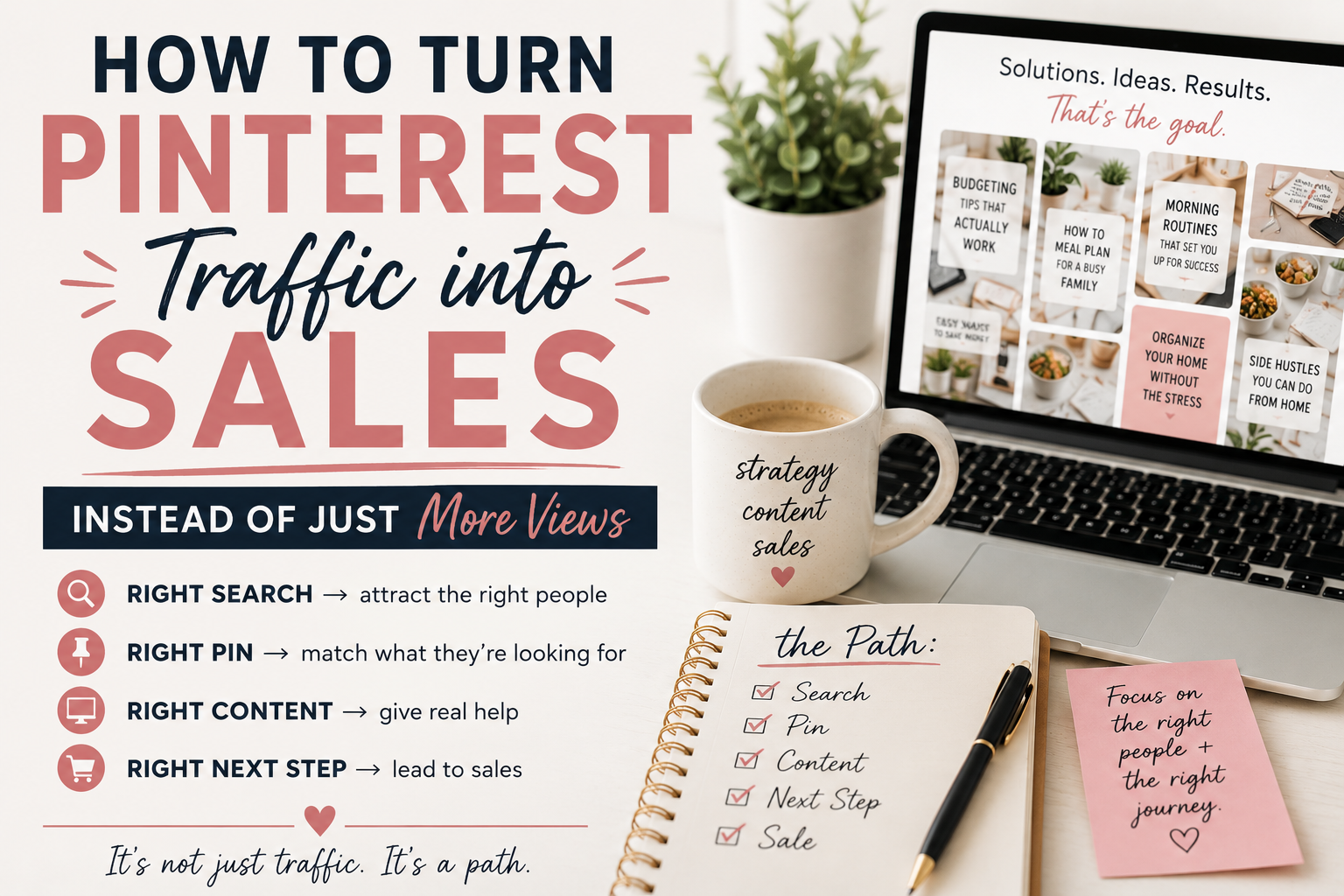
Search → Pin → Helpful Content → Next Step
And if you’re sitting there thinking…
Okay, I get THAT. But how do I organize all of these searches, Pins, posts, links, AND Products into one actual strategy?
Funny you should ask. 😂
Because that was exactly the question I had too.
I eventually stopped treating Pinterest, blogging, and selling as separate strategies and built a system that connects them.
How I Finally Got Pinterest, Blogging + Affiliate Marketing to Work Together →
Because you probably don’t need another 10,000 Pinterest impressions.
You need to know what you want the right person to do after they click. 🕸️


Leave a Reply