There was a point when I thought making money from a blog basically worked like this: write helpful blog posts, get people to read them, add some links to things they can buy, and hopefully make some money somewhere along the way.
Except I had one tiny problem. I was afraid to link to anything. I didn’t want my blog to look spammy. I didn’t want someone reading it and thinking every paragraph was secretly trying to sell her something. So I’d write the post, maybe add one link somewhere if I was feeling brave, hit publish, and call it done.
Which is kind of hilarious now because I’ve realized that’s part of the entire freaking point of a blog. People are clicking into a blog because they’re looking for something. They might need an answer, an idea, a tutorial, a product recommendation, or another article that explains the part they’re still confused about.
My job isn’t to get someone onto one blog post and then leave her there to magically figure out where to go next. I’m the middleman. If I know about another article that would help her, I should link it. If I use a product that solves the problem she’s trying to solve, I should tell her about it. If I created something specifically for the next step she’s trying to take, why would I hide it because I’m afraid of looking salesy?
That doesn’t mean stuffing random affiliate links into every paragraph. It means understanding why this person landed on this particular post and what she might reasonably need next.
And that completely changed the way I think about writing blog posts that actually lead to sales.
Start With What You Want the Blog Post to Do
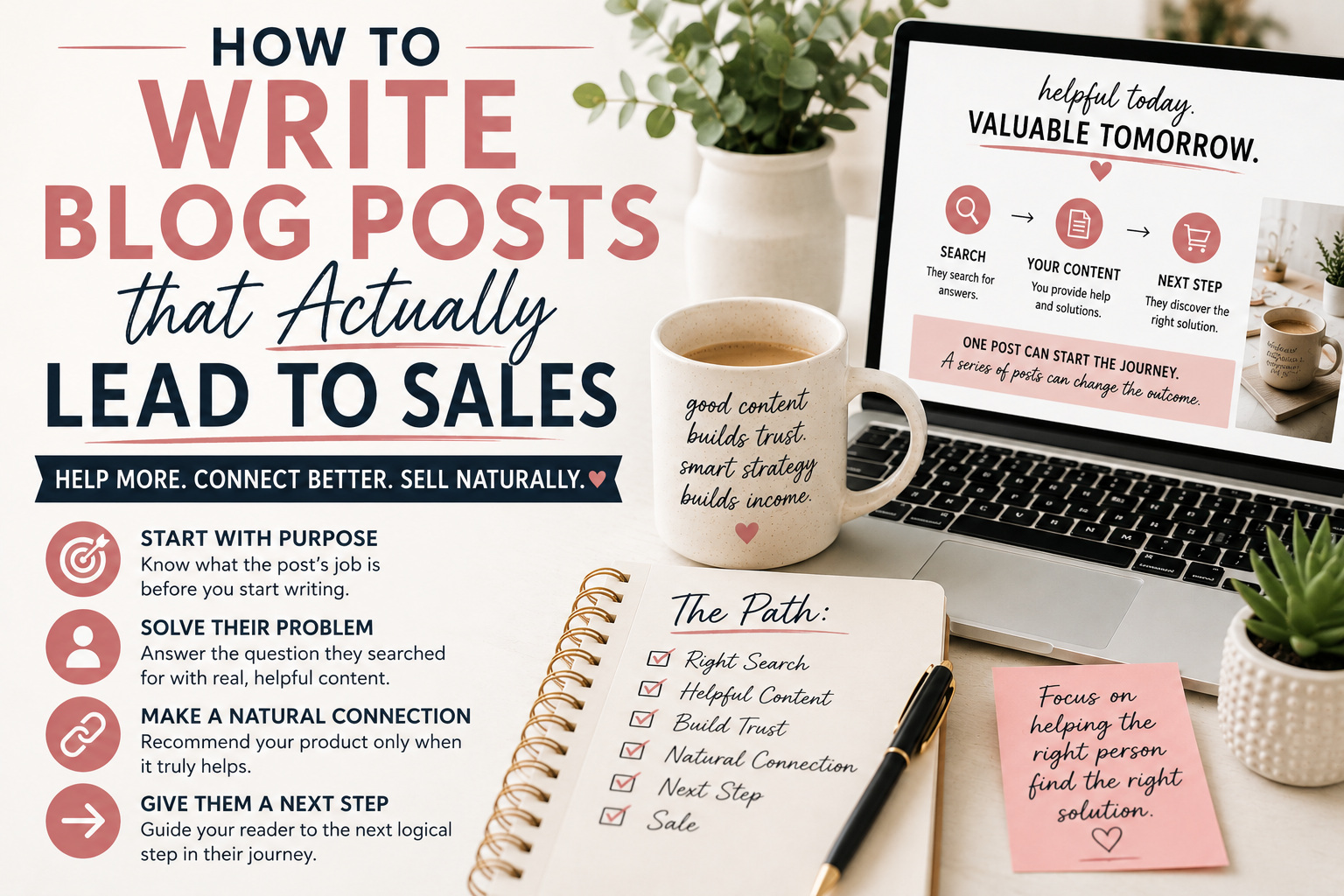
Before you write another post, ask yourself one question: What is this post’s job?
Sometimes the answer really is just to help your reader. Not every blog post needs to sell something, and I don’t think you should invent a product connection just because somebody told you every piece of content needs a call to action.
But if you’re intentionally writing a post to support a product, affiliate recommendation, service, membership, free resource, or another part of your business, it helps to know that before you start writing. Otherwise, it’s really easy to finish a great 1,500-word post and then sit there thinking, Okay… what the heck am I supposed to link to now?
That’s how completely unrelated products end up awkwardly shoved into blog posts. The reader came looking for one thing, you gave her the answer, and then suddenly you’re trying to convince her she needs something that has almost nothing to do with why she showed up.
Instead, think about where this post fits into the bigger picture. Maybe its main job is to bring new people to your website through search or Pinterest. Maybe it naturally introduces one of your products. Maybe it leads into another article where you go deeper. Maybe the best next step is a free resource that gets her onto your email list.
And sometimes it can do several of those things at once.
The point isn’t to force every blog post down one perfectly planned path. It’s to know why you’re writing it, who you’re writing it for, and where that person might reasonably want to go next.
Once you know that, you can work backward and write a post that actually connects to the rest of your business instead of sitting on your website all by itself.
Write for the Person Who Could Actually Need Your Product
Getting people to your blog is great, but if you’re trying to make money from it, you also have to think about who you’re bringing in and why they came.
Let’s say you sell a printable home-management binder. You could write a post about 10 Beautiful Kitchen Organization Ideas. It’s related to your niche, it could bring people to your website, and there is absolutely nothing wrong with writing it. But the woman searching for kitchen inspiration might just want to see some cute pantry containers. She hasn’t necessarily told us she needs an entire system for managing her home.
Now compare that to someone searching how to create a home management system, how to organize household information, or what to put in a home management binder. Those searches tell us a lot more about what she needs. She isn’t just browsing pretty pictures. She’s actively trying to figure out how to organize and manage information in her home.
And conveniently, you’ve created something that could help her do exactly that.
That doesn’t mean you write a halfway-helpful article and make her buy your product to get the actual answer. Answer the question she came for. Give her a genuinely useful blog post. Then, if your product makes the process easier, faster, more organized, or gives her something she would otherwise have to create herself, mentioning it makes sense.
Not everyone who finds that post will buy your product. Most probably won’t, and that’s okay. Some will read the article and leave. Some will click into another post. Some might save it to Pinterest and come back three months later.
But you’re creating a logical connection between what someone is already looking for and something you have that could help her.
That’s very different from getting traffic first and then trying to figure out what you can sell to it afterward.
Actually Answer the Question They Searched For
This part matters because getting someone to click your blog post is only the beginning. If your title promises How to Create a Home Management System, your post needs to actually help her create a home management system.
Don’t spend three paragraphs giving half an answer and then hide everything useful behind a checkout button. That’s frustrating as a reader, and it’s definitely not the kind of blog I want to build.
Give her something she can actually use. Explain what a home management system is. Show her how you organize yours. Talk about what information is worth keeping together, what didn’t work for you, and what made the biggest difference. Give her enough information that she could close your blog when she’s finished and actually do something with what she learned.
Your blog post should still be valuable even if that person never buys anything from you.
I used to think giving away too much information might mean someone wouldn’t need the product anymore. I’ve realized I think about it almost completely opposite now. Helping someone understand the solution can actually make it easier for her to recognize when a product would save her time or make implementing that solution easier.
So after you’ve taught her how to create the system, saying, “If you don’t want to build all of these pages from scratch, I created a printable home-management binder that already includes them,” doesn’t feel like you suddenly switched into sales mode. It’s simply another option.
She can take what you taught her and build it herself. She can buy the thing you already made. Either way, your blog post did its job.
The product isn’t holding the answer hostage. It’s helping her implement the answer you already gave her.
Don’t Force the Product Into the Blog Post
We’ve all read these posts. You’re happily learning how to organize your pantry and suddenly:
ANYWAY, HERE’S MY FAVORITE EMAIL MARKETING COURSE.
Ma’am.
How did we get here?! 😂
A product doesn’t become relevant just because you managed to physically place a link to it inside a blog post. You might have the perfect product for someone who reads your blog, but that doesn’t mean it belongs in every single article she might find.
The connection should make sense based on what the reader is already trying to accomplish. If you have to perform six paragraphs of mental gymnastics to explain why your product belongs there, it probably doesn’t.
I’ve actually started asking myself a much simpler question when I’m working on my own blog: After reading this, what might this person reasonably need next?
Maybe she needs a template that saves her from creating something from scratch. Maybe there’s another blog post that answers the next question she’s probably going to have. Maybe she needs a tool, a deeper tutorial, a comparison of her options, or she wants to know what I personally use.
And sometimes? She doesn’t need anything else from me right now.
That’s okay too.
The goal isn’t to cram the maximum number of links into every blog post. It’s to notice the places where a link would actually be useful and give the reader an easy way to keep going when she wants to.
That’s where your next piece comes from.
Give Your Reader Somewhere to Go Next
One of the simplest changes I’ve made to the way I think about blogging is this: I don’t want my blog posts to be dead ends.
Imagine someone finds one of your posts through Pinterest or Google. She reads the entire thing, gets exactly what she came for, and thinks, Okay, that was actually helpful.
Then she gets to the bottom and sees:
Thanks for reading!
And that’s it.
Where is she supposed to go? 😂
For a long time, I was so worried about looking spammy that I barely linked to anything. Now I realize I was making it harder for someone who actually liked my content to find more of it.
Giving someone a next step doesn’t automatically mean selling her something. Maybe there’s another blog post that answers the question she’s probably going to have next. Maybe you have a free resource that would help her put what she just learned into practice. Maybe there’s a product you personally use and recommend. Maybe your own product really is the logical next step.
The important part is that the path makes sense.
I’ve started thinking about my blog less like a giant pile of individual posts and more like something I’m intentionally connecting together. If someone enters through one article, I want her to be able to find the hallway to another useful part of my website instead of immediately having to go back to Google.
And yes, that can eventually lead to more sales. But it can also mean another pageview, another ad served, another post discovered, another email subscriber, or simply someone spending enough time on your website to realize, Oh. There’s actually a lot here for me.
So before you call a blog post finished, ask yourself one more question:
If she wants to keep going, where can she go from here?
Your Blog Posts Don’t Have to Work Alone
Once I stopped looking at every blog post as its own little island, I also stopped expecting every post to do everything.
One post doesn’t have to rank on Google, go viral on Pinterest, grow my email list, explain an entire topic, recommend every relevant resource, and make the sale all by itself. That’s a lot of responsibility for one little blog post.
Instead, I can build several pieces of content around the same person and the same problem. One post might answer the question she’s searching for today. Another can help her understand the next step. Another might compare her options or show her exactly what worked for me. Pinterest can bring her into any one of those posts months after I originally published it.
Eventually, one of those paths might lead to something I sell or recommend. The difference is that she didn’t land on my website and immediately get smacked in the face with a sales pitch. She found useful information, followed the pieces that mattered to her, and discovered the offer naturally because it actually fit what she was trying to do.
This also makes deciding what to write about so much easier.
Instead of constantly asking myself, “What should I blog about next?” I can start with something I already sell or recommend and ask better questions. What problem is this solving? What would someone search before she knew this solution existed? What questions would she have before buying it? What might stop her from trying it? What would she need help with afterward?
Suddenly, one product doesn’t give me one blog post idea. It can give me an entire web of useful content.
And not every piece in that web has to sell the product directly. Some pieces are there to get found. Some build trust. Some answer questions. Some help the reader take the next step.
Together, they’re doing a job that would be really hard for one blog post to do alone.
So, How Do You Write Blog Posts That Lead to Sales?
Start by knowing what you’re building toward. Maybe that’s one of your own products, an affiliate recommendation, a free resource, another blog post, or simply a topic you eventually want to become known for.
Then think about the person who would actually need it. What is she searching for before she knows your solution exists? What problem is she trying to solve? What questions does she have along the way?
Write the post that answers that.
Actually answer her question. Give her something useful enough that the post was worth reading even if she never buys a single thing from you. Then look for the natural places where another resource, article, recommendation, or product could help her keep going.
You aren’t trying to force every reader toward a checkout page. You’re building a website where the right reader can choose to keep following the path that makes sense for her.
And actually, that’s what you’re doing right now.
You came here because you wanted to know how to write blog posts that actually lead to sales. But now you know the individual blog post isn’t really the entire strategy.
Which naturally brings up another question:
How do you connect the blog posts, Pinterest traffic, affiliate links, and products into one intentional system instead of creating all of them separately?
That was the question I couldn’t stop asking either. Eventually, I started building backward from what I actually wanted someone to find instead of creating a bunch of disconnected content and hoping it somehow worked together.
How I Finally Got Pinterest, Blogging + Affiliate Marketing to Work Together →
Because a blog post doesn’t have to scream BUY SOMETHING to contribute to a sale.
It needs to help the person who found it, connect naturally to the rest of what you’ve built, and give her somewhere to go if she wants to keep going.
That’s the job.


Leave a Reply