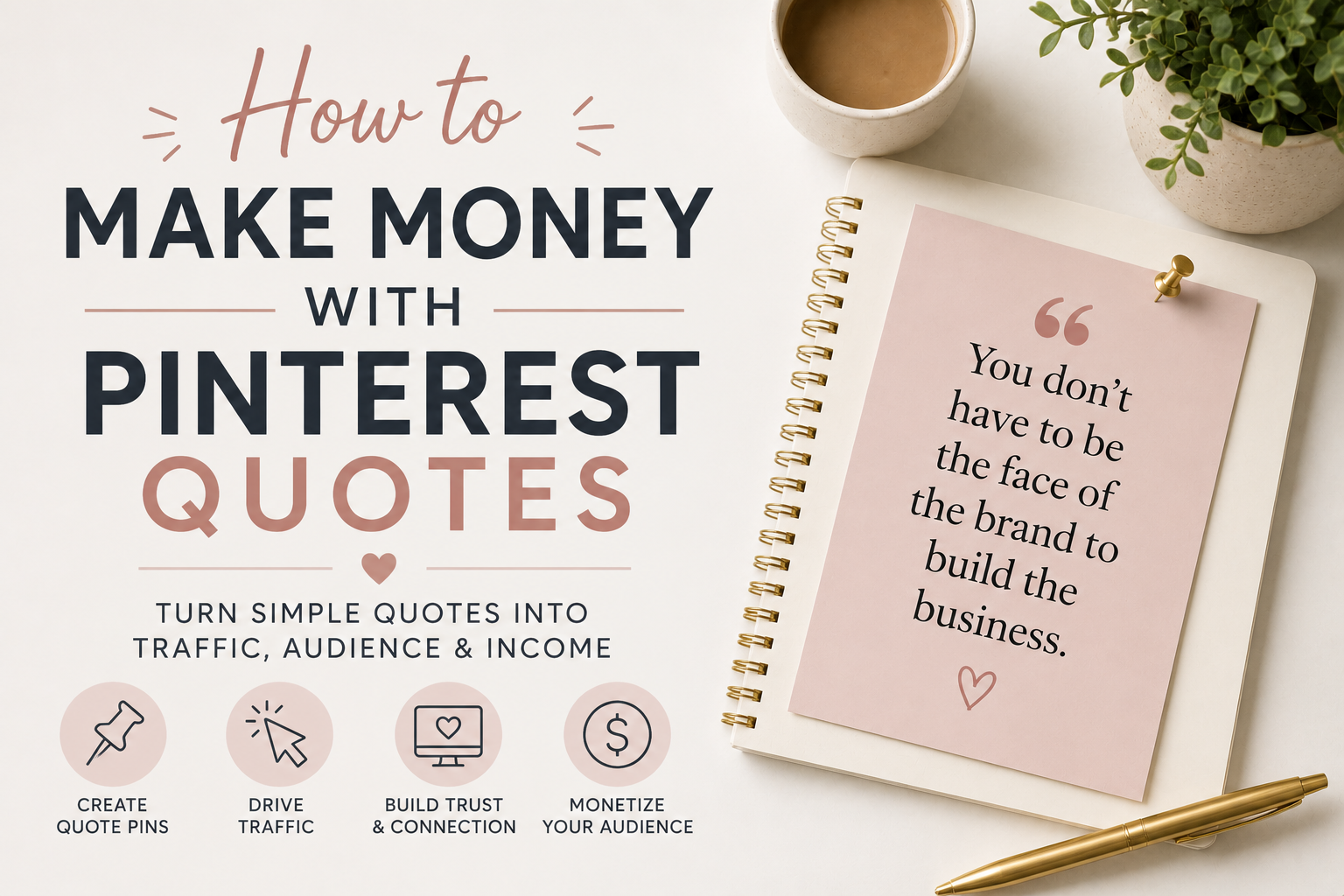
Before we talk about how to make money with Pinterest quotes, I want to point out something you may not have even thought about when you landed on this page.
You clicked a quote Pin to get here.
You were on Pinterest. You saw a few words that caught your attention enough to stop, read them, and then click because you wanted whatever was behind them. Now you’re here, on my website, reading an entire article about using quote content on Pinterest.
That tiny little journey you just took is basically the entire strategy I’m about to teach you. 😂
The quote itself didn’t make me money because you looked at it. Pinterest didn’t send me a check because you stopped scrolling. The Pin had a much simpler job: it got the attention of someone interested in the exact subject I wanted to talk about and brought that person somewhere I could go deeper.
In this case, that person is you.
THAT is why I’ve become so interested in Pinterest quotes as more than just pretty content that gets saves. A quote Pin can become an entrance into a much larger business, and once I understood that, I started looking at quote content very differently.
A Pinterest Quote Doesn’t Need to Make the Money
When people ask how to make money posting quotes on Pinterest, I think it’s easy to picture the money happening directly on Pinterest. You post a quote, it gets thousands of views, and somehow those views become dollars. That isn’t really the business model I’m talking about here.
Pinterest can be valuable because the Pin can lead somewhere else. Someone can discover a quote, resonate with what it says, and then click through to your website, store, free resource, product, or another destination connected to your business. The quote is getting the attention, but the thing behind the quote is where the relationship can continue.
That’s exactly what happened when you clicked the Pin that brought you here. I didn’t need to explain an entire Pinterest quote strategy on one graphic. I only needed the words on that Pin to connect with the right person strongly enough that she wanted more. Once you’re here, I have room to explain what I mean, show you how the strategy works, tell you what I’ve experienced, and give you something you can actually use.
That distinction matters because it takes a LOT of pressure off the individual piece of content. Every quote doesn’t need to make a sale. It doesn’t need to explain your product. It doesn’t need six calls to action crammed onto the graphic. It doesn’t even necessarily need to mention what you’re selling.
Sometimes its entire job is simply to bring the right person into the room.
The Right Quote Can Attract the Right Audience
If I were intentionally using Pinterest quotes to build income, I wouldn’t start by making 500 random motivational graphics and hoping one went viral. I’d start by deciding exactly who I wanted those quotes to attract.
Broad inspirational content can absolutely get attention, but attention by itself isn’t necessarily valuable to a business. A quote about believing in yourself could resonate with an entrepreneur, a college student, a woman going through a breakup, a mom struggling through a hard season, someone trying to lose weight, or somebody who simply liked the picture behind the words. All of those people can save the Pin, but they don’t necessarily have enough in common to make whatever comes after the click relevant to all of them.
Now imagine creating quotes specifically for homeschool moms. You could write about trusting yourself as a parent, letting childhood move slowly, not recreating public school at the kitchen table, comparison, difficult homeschool days, learning through everyday life, or wondering whether you’re doing enough. The person who stops for those words is giving you information about herself simply by responding to the content.
If that homeschool quote leads to a genuinely helpful article about homeschooling, the transition makes sense. Inside that article, maybe you recommend a curriculum you use as an affiliate. Maybe you have one of your own homeschool printables. Maybe there’s a free resource that invites her onto your email list. Whatever happens next, it continues serving the SAME person who was originally attracted by the quote.
That’s the part I care about.
The goal isn’t to make every Pin appeal to as many human beings as possible. The goal is to create content that repeatedly attracts the type of person your business is built to help.
The Quote and the Destination Need to Belong Together
This is where Pinterest quotes can become strategic instead of simply inspirational.
Let’s say you have a blog post about starting a faceless Instagram account. You could absolutely create a traditional Pinterest graphic that says “How to Start a Faceless Instagram Account.” There’s nothing wrong with that, and I use straightforward search-based Pins too.
But you could also create an actual quote that speaks to the person who would want that article.
Maybe the primary words on the Pin say:
You don’t have to be the face of the brand to build the business.
That’s content on its own. Someone can read it, save it, share it, or keep scrolling without ever clicking anything. We aren’t withholding the useful part and forcing her onto the website to figure out what the Pin means.
But the person who reads those words and thinks, “WAIT. That’s exactly what I want to do,” may want more.
So that Pin leads to the article about building a faceless Instagram account.
Now the quote and the destination belong together. The quote caught the attention of someone interested in building without showing her face, and the article teaches her how that kind of account can actually work.
That’s a much stronger path than creating a quote about marriage because marriage quotes happen to be getting tons of saves and then sending everyone who clicks to your article about affiliate marketing. 😂 You might get traffic, but you’ve attracted people for the wrong reason.
The quote should act like a filter.
The right words help the right person recognize herself in your content.
Simple Quote Pins Can Still Be Strategic Pinterest Content
One thing I really love about this strategy is that the Pin itself doesn’t need to become a graphic-design project.
Sometimes the words are enough.
You might put them over a beautiful image related to the niche. You might use a simple solid-color background. You could create a recognizable visual style so your content starts feeling cohesive without making every Pin identical.
I would much rather have a simple design with words that make the right person stop than an absolutely gorgeous graphic that doesn’t say anything she cares about.
That’s because quote content works through recognition. People save and share words that express something about who they are, what they’re going through, what they believe, what they want, or who they’re trying to become. Someone saves a motherhood quote because she wants to remember that season. Someone sends a business quote to a friend because they’ve had the exact conversation it describes. Someone saves a debt-free quote because she needs to see it again the next time she wants to give up.
Those actions also teach you something about the audience.
If one particular type of quote keeps getting attention, that’s not just a nice Pinterest number. It’s information. Those words connected with something your audience cares about.
And that gives you ideas for what to create next.
How a Quote Pin Can Lead to Affiliate Income
Affiliate marketing is one way this traffic can eventually turn into income, and I want to show you the whole path because this is where the model starts making much more sense.
Imagine you create Pinterest content for women who want to build income online without becoming traditional influencers. You publish quotes about faceless content, entrepreneurship, creating something of your own, and building income from home.
One of those quotes leads to a full article about creating a faceless business.
Inside that article, you actually teach her how the model works. You explain the strategy, give examples, help her understand what she needs, and provide enough information that she could leave the article without spending anything and still be better off than when she arrived.
But maybe there’s a program, tool, template, or other resource that helps her implement what you’ve taught. If you’re an affiliate for that product and genuinely believe it’s useful, you can introduce it as the next step for someone who wants more help.
Now look at how differently that sale happened.
She wasn’t scrolling Pinterest looking for an affiliate link.
She wasn’t thinking, “I hope somebody makes a commission off me today.” 😂
She saw words that resonated with something she already wanted. Those words led to useful information. That information introduced her to something that could help her go further. Then she decided whether it was right for her.
The quote didn’t make the sale.
It started the path that made the sale possible.
The Same Strategy Can Sell Your Own Products
This doesn’t only work with affiliate products. The exact same strategy can lead people toward something you’ve created yourself.
Imagine you build Pinterest content around debt-free motivation. You create quotes about choosing freedom over looking wealthy, celebrating tiny progress, staying consistent when debt payoff feels painfully slow, and refusing to let comparison wreck your financial goals.
Those Pins could lead to helpful articles about budgeting, saving, or paying off debt. Somewhere inside those articles, you might have your own debt tracker, savings challenge, budgeting spreadsheet, or another product that helps the reader actually do what you’ve been encouraging her to do.
The product doesn’t feel random because the entire path is connected.
The quote attracted someone trying to change her financial life. The article helped her understand something about changing her financial life. The product gave her a tool to continue changing her financial life.
You could apply the exact same structure to fitness trackers, homeschool printables, journals, planners, business templates, digital guides, or practically anything else where the product serves the same audience the quote attracted.
That’s why I don’t really think about “monetizing a quote” anymore.
You’re monetizing the business built around the person the quote attracts.
Your Quote Pin Can Lead to More Than a Product
A sale doesn’t have to happen during that first visit either.
Maybe someone clicks your quote, reads your article, and doesn’t buy anything.
That doesn’t automatically mean the Pin failed.
Maybe she joins your email list because you have a free resource she wants. Maybe she reads three other articles. Maybe she remembers your website and comes back through another Pin two weeks later. Maybe she eventually buys something months from now.
That’s why I like having a website behind my Pinterest strategy. A tiny quote gives me enough space to get someone’s attention, while the blog gives me enough space to actually HELP.
I can take one thought and turn it into a much deeper conversation. I can answer the question she searched for, give examples, tell her what I’ve personally experienced, connect her to another helpful article, and introduce a relevant product when it makes sense.
A blog isn’t required for every Pinterest quote strategy. Depending on what you’re building, your Pin might eventually lead to a store, a product page, a free resource, an email signup, or another useful destination.
But whatever sits behind the Pin should continue the conversation the Pin started.
You clicked because something about the quote interested you.
Imagine how annoying it would have been if you landed here and I started talking about organizing your kitchen cabinets. 😂
The click created an expectation.
The destination needs to deliver on it.
Don’t Turn the Quote Into an Advertisement
This is where I think it’s very easy to ruin the thing that made quote content work in the first place.
You discover quotes get attention and immediately think:
GREAT. I’LL PUT MY OFFER ON ALL OF THEM.
But the reason people stop for quote content is because they actually want the content.
Let the quote be useful, relatable, funny, inspiring, encouraging, or thought-provoking on its own. The person should be able to see the Pin, get something from it, and continue scrolling without feeling like you tricked her.
The business happens because some of those people want to go deeper.
That’s another reason Pinterest is so interesting. You don’t have to create one Pin and pray it carries your entire marketing strategy. You can create multiple entrances into the same piece of content.
Some might be traditional search-based graphics with a clear title.
Some might be quote Pins like the one you clicked to get here.
Some might use a different hook or angle.
Then you can watch what happens.
Which ones get impressions? Which get saved? Which actually earn clicks? Which topics repeatedly attract attention? Which designs seem to work better? Which Pins send the right people into your website?
Now you’re learning from actual behavior instead of guessing.
One Quote Can Become Content Across Multiple Platforms
Another reason I like quote content is that a good idea doesn’t necessarily need to live on Pinterest forever.
Once you’ve written something that genuinely resonates with your audience, you have a piece of content.
That quote could potentially become an Instagram post. You might put it over video and turn it into a Reel. It could become a Facebook post, a Thread, part of an email, or the opening thought behind a longer article.
You don’t have to publish every idea everywhere, and I definitely wouldn’t turn one quote into seven new obligations. 😂 The point is simply that the creative work doesn’t have to start completely from scratch every time you change platforms.
The core message can travel.
Pinterest can also help you identify which messages are worth expanding. If one quote repeatedly gets saved, clicked, or shared, I’d pay attention to the IDEA behind it. Something about those words is connecting.
Maybe there’s another Pin there.
Maybe there’s an entire article there.
Maybe there’s a product problem hiding underneath it.
Maybe it’s something your audience needs to hear more about.
Your quote content isn’t only marketing.
It’s research.
Pinterest Is Where Quote Content Finally Clicked for Me
I originally became interested in quote pages a long time ago because, if I’m being completely truthful, I thought they sounded like an “easy” way to make money.
I bought a program that taught how to build and monetize quote pages, started experimenting, and then did something I’m embarrassingly talented at doing.
I got distracted. 🫣🤣
I didn’t take my original quote page seriously enough. I didn’t stick with it long enough to really build the audience, and I gave up before I actually made anything from the page.
Then, hilariously, I continued trying to piece together strategies on my own even though I literally owned a program teaching me how to do the thing. 😂
But I never completely stopped using quote content.
And Pinterest is where the business model finally started making sense to me in a different way.
I saw how much attention quotes could get there, but more importantly, I saw how that attention could MOVE.
The quote didn’t have to be the final destination.
It could bring someone somewhere.
I’ve had quote content bring people toward my blog content about Quote Page Collective—the exact program I originally bought to learn how to build and monetize quote pages.
So think about how ridiculously full-circle this has become.
A quote Pin can bring someone to an article teaching her how quote Pins can bring someone to an article. 😂
And that article can eventually lead the right person toward the program that teaches the larger quote-page business model.
We’re not just talking about the strategy right now.
You’re literally inside it.
What I Would Do If I Started a Pinterest Quote Strategy Today
If I were building this from scratch, I would start backward.
I wouldn’t open Canva and make 200 quotes first.
I’d decide what I ultimately wanted the content to lead toward. Maybe that’s an affiliate product. Maybe it’s my own digital product. Maybe it’s an email list. Maybe it’s a website where several of those things exist.
Then I’d create the helpful content that sits between Pinterest and the offer.
Only after I understood the destination would I start creating quote Pins.
I’d ask what words would genuinely resonate with the person that destination was created for. I’d create simple graphics around those ideas and give each Pin a clear connection to whatever happens after the click.
Then I’d publish enough of them to learn.
Some quotes might get a ton of impressions but very few clicks. Some might get saved constantly. Another might get fewer impressions but send significantly more people to my website.
Those differences matter.
If the goal is eventually making money, I don’t want to optimize only for the prettiest Pinterest analytics screenshot. I want to know whether my content is bringing the right people into the business.
That’s the measurement that matters most.
The Quote Isn’t the Business. It’s the Entrance.
If there’s one thing I want you to leave this article understanding, it’s this:
You do not need the quote itself to make money.
You need it to have a job.
Maybe its job is attracting a homeschool mom who eventually buys one of your printables. Maybe it brings a content creator to an article where you recommend an affiliate product. Maybe it introduces someone to your email list. Maybe it gets the exact right person onto your website for the first time.
You clicked a quote Pin to get here.
That Pin did its job.
And if you’re now sitting here thinking, “Okay, I understand Pinterest quotes… but how do you build an entire BUSINESS around quote content?” that’s the exact next question I’d want you to ask.
I’ve broken that down in How to Make Money With a Quote Page: The Business Behind Faceless Quote Content.
READ: HOW TO MAKE MONEY WITH A QUOTE PAGE →
That’s where I go beyond Pinterest and explain the larger quote-page model: how the content attracts an audience, how quote pages can work across multiple platforms, and how things like digital products and affiliate marketing can fit behind the audience you’re building.
Because the Pin that brought you here isn’t just an example.
It’s proof of the concept.
You found the quote. The quote brought you here. And now you get to decide whether you want to go one step deeper.


Leave a Reply