One of the biggest misconceptions about theme pages is that growing the page and monetizing the page are basically the same thing. They’re not. You can have thousands of followers, posts getting shared all over the place, and enough likes to make you feel very important on the internet while still making approximately $0.
That’s because attention and income are two different things. Your content gets the attention, but your business model determines what happens with that attention. If you already have a theme page—or you’re thinking about building one—the question shouldn’t only be how you’re going to get more followers. You also need to understand who those followers are, why they came to you in the first place, and what they might reasonably want from you beyond free content.
This is actually good news because it means you don’t necessarily need a massive audience before you can start thinking about money. A smaller page built around a very specific person can have a much clearer path to monetization than a giant page full of people who don’t have much in common beyond liking a few of your posts.
Before you add products, affiliate links, a store, or anything else, start by understanding the audience. Everything we’re going to build after that becomes much easier.
Start With Why People Follow Your Theme Page
Look at the audience you already have or the audience you’re trying to build and ask why those people are there. A fitness motivation page attracts people interested in fitness. A budgeting page attracts people trying to improve their finances. A motherhood page attracts moms who relate to the experiences you’re creating content around. A business motivation page attracts entrepreneurs or people who want to become entrepreneurs.
That sounds ridiculously obvious, but it’s where monetization strategies can go sideways. Someone builds an audience first and THEN starts frantically looking around for anything she can sell. Suddenly the fitness page is promoting a completely unrelated business course because the commission is good, the motherhood page is recommending random software, and the entire thing starts feeling like an internet yard sale. 😂
Instead, I want the offer to feel like a continuation of the reason someone followed the page.
Imagine someone follows your account because she’s trying to pay off debt. She likes your budgeting content, saves your reminders about staying consistent, and follows because your posts help her keep going when she’d really rather order takeout and pretend the credit card doesn’t exist for the evening.
What could genuinely help that woman next?
Maybe it’s a debt-payoff tracker. Maybe it’s a budgeting spreadsheet. Maybe she would love a savings challenge. Maybe there’s a financial tool, book, app, or program you’ve personally used and genuinely recommend.
Those offers make sense because they’re connected to something she already wants. You’re not trying to manufacture a need so you can sell her something. You’re paying attention to the need that brought her to your content in the first place and finding additional ways to help.
That’s the foundation I would build every monetization strategy around.
You Don’t Need 100,000 Followers to Start Making Money
I think people sometimes imagine theme-page monetization happening in a very specific order. First you create the page. Then you grow it to some enormous number of followers. THEN you’re finally allowed to figure out how to make money.
Apparently once you reach 100,000 followers, the Internet Money Fairy arrives and asks for your banking information. ✨😂
It doesn’t really work like that.
A small audience can contain buyers. More importantly, a small and specific audience can sometimes be much easier to serve because you understand exactly why those people are there.
Imagine having 5,000 followers who are specifically interested in homeschooling preschoolers. You could create a preschool-at-home printable bundle and immediately understand why that product might appeal to the people following you.
Now compare that with having 100,000 people following a page full of completely generic motivational content. Maybe they’re there for business inspiration. Maybe they’re fitness people. Maybe they’re college students. Maybe they’re moms. Maybe they just liked a quote you posted three years ago and forgot they follow you.
Which audience gives you a clearer product to create?
I’ll take the 5,000 very specific people.
This doesn’t mean audience size is irrelevant. Obviously, having more of the right people can create more opportunities. But follower count by itself isn’t the business. Audience fit matters, and that’s something you can start building intentionally from the beginning.
Create Something Your Audience Already Needs
One of the most natural ways to monetize a theme page is with your own digital product because you can create something specifically for the people you’ve already gathered.
And please don’t hear “digital product” and immediately decide you need to disappear for four months and emerge with a 97-video course, workbook, membership, resource library, three bonuses, private community, and emotional damage.
A useful digital product can be incredibly simple. It might be a printable, template, spreadsheet, planner, tracker, guide, workbook, mini-course, challenge, or another tool that helps your audience do something they already want to do.
Let’s say you run a home-organization page and notice that your audience constantly responds to content about keeping up with household routines. Maybe you create a printable cleaning schedule. If you run a fitness motivation page, you could create a habit tracker or workout planner. A book page could create a reading journal. A homeschool page could create educational printables. A business page could sell templates or content resources.
The strongest product ideas often come directly from the content you’re already creating. Pay attention to what gets saved. Read the comments. Notice what people ask you. Look at the DMs you receive. Watch for frustrations that keep appearing.
Your theme page is basically giving you market research every time you publish.
Maybe you assumed your budgeting audience needed a giant course about managing money, but every time you share something about tracking debt, people save it like crazy and ask where they can get your tracker.
Maybe they just want the freaking tracker. 😂
You don’t always have to sit alone trying to invent the perfect product. Create useful content, listen to the audience, and let their behavior help you identify what would actually be useful enough to sell.
You Can Monetize Without Creating a Product
Creating your own product isn’t the only option. Affiliate marketing can give you a way to monetize a theme page without having to build the thing you’re recommending yourself.
With affiliate marketing, you recommend a product or service created by someone else and can earn a commission when someone purchases through your tracking link according to that program’s terms. This can be especially useful when you’re still learning your audience because there may already be excellent products that solve the exact problems you’re creating content around.
A fitness page could recommend equipment, apps, programs, clothing, or other relevant products. A book page could recommend books. A homeschool page might recommend curriculum, supplies, educational resources, or memberships. A creator page could recommend software, courses, design tools, templates, or equipment. A home-organization page might recommend the actual products people can use to organize their homes.
The possibilities are going to depend entirely on the audience, which brings us right back to the same rule: the recommendation should make sense for why someone follows you.
I wouldn’t choose an affiliate product simply because it pays the highest commission. If you have to completely change the subject every time you want to make an offer, that’s probably a sign the product doesn’t fit naturally into the business you’re building.
I’d rather recommend something I can create genuinely useful content around.
If my theme page is for content creators and I recommend a design tool, I don’t have to post “BUY MY FAVORITE DESIGN TOOL” seven times a week. I can teach people how to create better graphics, build reusable templates, create content faster, choose fonts, batch posts, or make faceless content.
I’m helping with the problem.
Then when the product makes implementing what I’ve taught easier, recommending it becomes a natural next step.
That’s a completely different experience than interrupting unrelated content with an affiliate link and hoping somebody happens to buy.
Your Theme Page Can Support More Than One Income Stream
This is where theme pages start getting really interesting to me because you don’t necessarily have to decide that you’re building an “affiliate marketing page” or a “digital product page.”
Those are monetization methods. They don’t have to become the identity of the business.
Over time, the same audience can support several offers.
Maybe you start by recommending one affiliate product you genuinely use. Later, you create a $9 printable based on something your audience keeps asking for. Eventually, you build a larger digital product. Maybe you add another affiliate recommendation. You could have a store where all of those resources live together.
Now different people can buy different things based on what they actually need.
One follower might discover you today and immediately buy your $9 template. Another person might never want that template but purchases a $67 affiliate product you recommend because THAT solves her problem. Someone else might consume your free content for six months, join your email list, and eventually buy a larger product when she’s ready.
They’re all part of the same audience.
They simply don’t all need the same thing at the same time.
That’s why I like thinking about monetization as an ecosystem rather than searching for the one magical thing that makes a theme page profitable.
And no, that doesn’t mean you should leave this article and immediately create seven income streams. 😂 Start with the one that makes the most sense based on where you are right now. Once that path is working, you can add another.
Your Content Doesn’t Have to Make the Sale
This is one of the biggest mindset shifts I’ve made around content in general.
Every post does not need to directly make money.
Sometimes the content’s job is getting the right person somewhere else.
Maybe your theme page sends someone to your website. Maybe a post leads to a helpful blog article. Maybe your profile sends people to your store. Maybe you offer a free resource that grows your email list.
The sale can happen farther down the path.
This is something I especially love about Pinterest because Pinterest has become my strongest platform for quote content. Someone can discover a ridiculously simple quote Pin, resonate with it, click it, and suddenly she’s on my website.
Now the quote didn’t have to explain my entire business.
It had ONE job.
Get the right person’s attention and give her a reason to take the next step.
Once she’s on my website, the blog post can do a different job. It can fully answer whatever question she had. Somewhere inside that helpful content, there may be a relevant resource or product that helps her go further. She can choose whether she wants it.
Now we have a path.
A simple piece of content created the entrance, but the rest of the business didn’t have to fit inside that one piece of content.
That’s a much more useful way to think about content than constantly asking, “Did this post make me money?”
Maybe it wasn’t supposed to make the sale.
Maybe it was supposed to bring someone into the room.
Build Something You Own Behind the Page
If I were serious about turning a theme page into a long-term business, I would eventually want some of the audience moving somewhere I have more control.
Social media platforms are incredibly useful for discovery, but we don’t own them. We don’t control the algorithm, how much reach we get, which features stick around, or what changes six months from now.
An email list is one way to build an asset beyond the platform.
Maybe someone finds your theme page and loves your content. You offer a free resource that’s directly related to why she follows you, so she signs up to receive it.
Now you have a way to continue the relationship even if she doesn’t see tomorrow’s Instagram post.
You can continue teaching through email. You can share stories. You can recommend products. You can launch something you’ve created. You can send her back to useful content on your website.
A website can serve a similar role in the larger business. Instead of every social post being a dead end, your content can send people toward longer-form resources that continue helping them and introduce them to the products you recommend.
That’s why I don’t necessarily want the theme page to BE the entire business.
I want it bringing people INTO the business.
What About Getting Paid Directly by the Platform?
Depending on the platform, your location, your account, your eligibility, and whatever programs exist at the time you’re reading this, there may also be ways to earn directly through the social platform itself.
That can absolutely become part of your monetization strategy.
I just wouldn’t want it to be the only one.
Platform programs change. Eligibility requirements change. Payouts can change. The type of content being rewarded can change. A program that exists today may look completely different in the future.
If I’m already doing the work of building an audience, I’d rather use that audience to build things I have more control over too.
So maybe the page eventually earns money directly from the platform. Great. Let that become another stream.
But the same page could also sell your digital product, promote affiliate products, grow your email list, send people to your website, and create other opportunities.
Now the business isn’t completely dependent on one company’s monetization program.
Think of Your Theme Page as the Top of the Business
This is the concept that made theme-page monetization make much more sense to me.
The page itself doesn’t necessarily need to BE the business.
It can sit at the top of it.
Your content attracts people. Some of those people follow. Some click. Some join your email list. Some read your website. Some buy a small product. Some purchase an affiliate product you recommend. Some stick around for months before they ever spend a dollar.
That’s completely normal.
Your theme page is continuously bringing new people into everything you’ve built behind it.
Once you start thinking this way, you can stop expecting every individual post to produce money immediately. One post might bring new followers. Another might send people to your website. Another might build trust around a problem your product eventually solves.
Those posts aren’t failing because they didn’t directly create a sale.
They’re doing different jobs inside the same business.
The question becomes less about whether one specific post made money and more about whether your overall content system is consistently attracting the right people and moving some of them toward the things you’ve built for them.
A Quote Page Is Simply One Version of This Business Model
If you’re interested in theme pages but haven’t decided exactly what kind of content you want to create, quote pages are one of the simplest versions of this model.
A quote page is essentially a theme page where the primary content format is relatable, inspirational, funny, aspirational, or emotionally resonant words created for a particular audience.
A fitness quote page attracts people interested in fitness. A business quote page attracts entrepreneurs. Homeschool quotes attract homeschoolers. Motherhood quotes attract moms. Faith-based quotes attract people interested in faith.
The quote itself isn’t what you’re selling.
It’s the content you’re using to gather the audience.
Once I understood that distinction, quote pages became much more interesting to me because I stopped asking, “How does posting inspirational words on the internet make money?”
That’s not really the right question.
The better question is:
“Who does this content attract, and what happens after they find me?”
That’s where the business lives.
Build the Path From Follower to Customer
If you’re trying to monetize your theme page, don’t begin by asking how you can squeeze money out of the people following you. Start by mapping the path between what they originally came to you for and what could genuinely help them next.
Someone discovers your content.
Why does she follow?
What does she continue learning from you?
What does she begin trusting you about?
What problem does she have that you can help solve?
What product makes sense as the next step?
Where does she encounter that product?
And what happens if she isn’t ready to buy it today?
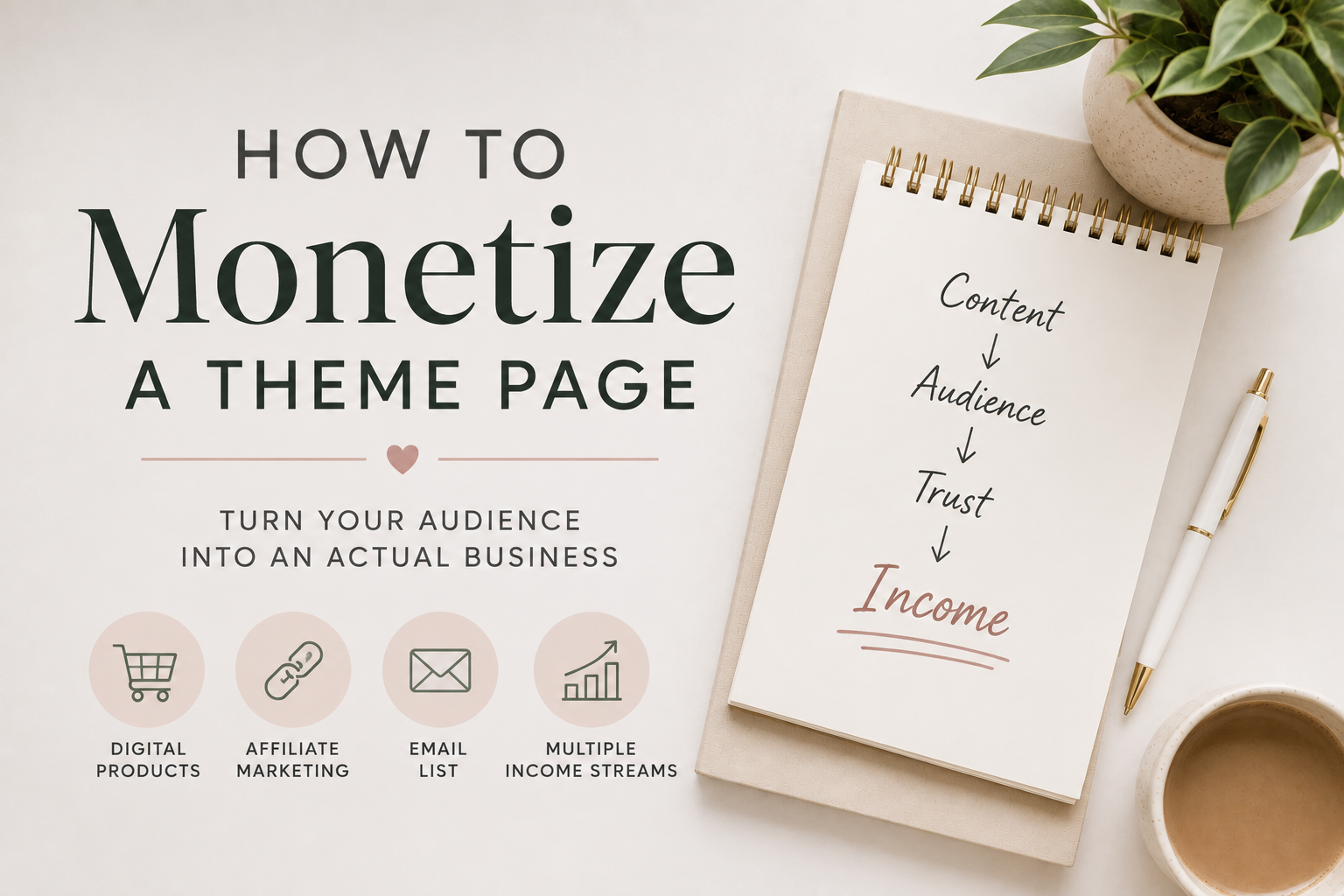
Your first version of that path can be incredibly simple. Maybe it’s content → digital product. Maybe it’s content → blog post → affiliate product. Maybe it’s content → email list → product.
You do not need a 14-step funnel with 47 automations before you’re allowed to make your first $9 sale. 😂
Build the shortest useful path between the person your content attracts and something that genuinely helps her.
Then pay attention to what happens.
If Your Theme Page Is, or Could Become, a Quote Page
If quote content is the version of this business model that interests you, I’ve broken that specific strategy down much further in How to Make Money With a Quote Page: The Business Behind Faceless Quote Content.
READ: HOW TO MAKE MONEY WITH A QUOTE PAGE →
I go deeper into how quote content can attract a specific audience, how it can expand across multiple platforms, and how things like digital products and affiliate marketing can fit behind the page.
But whether your theme page is built around quotes, memes, educational content, tutorials, or something completely different, the monetization principle is the same.
Don’t build an audience and then ask how to make money from random people you’ve collected.
Build an audience you understand. Help them through the free content. Pay attention to what they need next. Then create or recommend something that genuinely helps them take that next step.
That’s when a theme page stops being another social media account you’re responsible for feeding every day.
It starts becoming an actual business.


Leave a Reply